
INTERNATIONAL PAYMENTS
Currency in procurement
Industry best practices
Recognise FX clauses
Currency Risk Management
FEEDING THE RIGHT QUESTIONS
What exchange risk is worn by the business?
What exchange rate risk has been passed to the vendor to price in?
Which party is in charge of determining the exchange rate?
Are there FX clauses forcing a re-price?
Are benchmark exchange rates sourced from retail or wholesale data?
Are future cash-flows priced at spot rates or the relevant forward rates?

SEEKING TRANSPARENCY
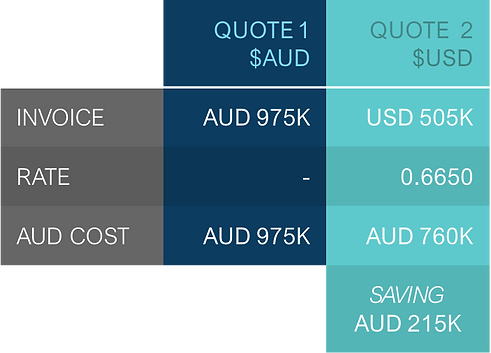
Suppliers and vendors often apply significant margins to invoices priced in a currency different from their own. This is also found when domestic resellers source goods from overseas.
If a tender/quote needs to be in a currency different to the origination currency, also seek a quote in the supplier’s preferred currency. This allows the supplier to provide an alternative quote which eliminates currency risk passed to them.
Two quotes will increase transparency and provide you with an opportunity to assess which option is cheaper at prevailing exchange rates.
Contact us to find out more about accurately applying the right forward exchange rates to match milestone payment dates and how to best manage any market risks.


AVOIDING RISK MANAGEMENT
Currency volatility in cross-border transactions can weigh heavily on the bottom line. Yet, businesses often choose to not manage certain risk and roll the dice on related costs.
Why?
1. PROSPECT THEORY
Prospect theory studies show that people generally take more risk to avoid a loss and take less risk to protect a gain.
As a result, businesses will risk budget/cost uncertainty, just to avoid potentially ‘losing’ against better spot rates.
This natural tendency can lead to inconsistent and costly decisions.
Risk management is about protecting gross margin.
2. BUSINESS FINANCIAL HEALTH
Firms with limited funds avoid risk management with collateral requirements.
Similarly, households with financial difficulty may reduce certain insurance policies to reduce expenses.
The puzzle, firms with limited funds should actually be more concerned about budget certainty.
Evidence shows firms with stronger balance sheets and capitalisation hedge a lot more often.
Not hedging known future payables in an alternate currency
is speculating (rolling the dice) your gross margins with
unknown future exchange rates.